INSIGHT LITERATURE REVIEW
Key Literature Review on Inclusive Teaching
ACCESS THE LITERATURE REVIEW HERE!
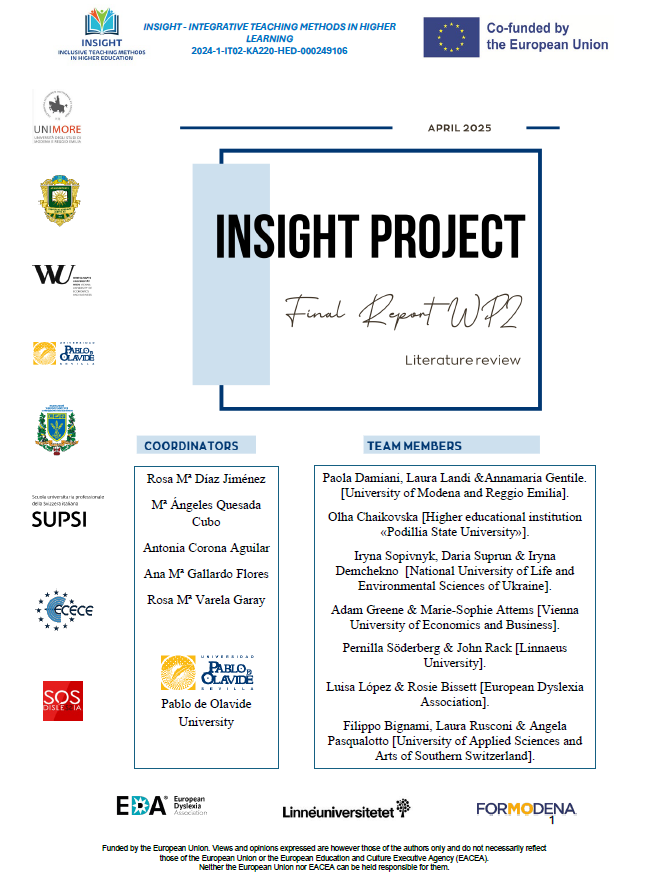
The INSIGHT Project (Inclusive teaching methods in higher education) is pleased to announce the publication of its Literature Review, developed under Work Package 2 (WP2). This review provides essential background research for the INSIGHT project, synthesizing existing evidence on inclusive teaching strategies in higher education.
The literature review’s primary focus is identifying effective practices that support all students, with a specific emphasis on young adult learners with Specific Learning Disabilities (SLD), particularly dyslexia, in European university settings.
This review is essential reading for educators, administrators, and policymakers committed to fostering equitable and effective learning environments in universities across Europe and beyond.
Data overview and key takeaways: inclusion as a systemic necessity
Our review analysed recent literature on the learning performance of young adult learners with SLD in higher education, focusing on inclusive strategies and didactic approaches in EU countries. The findings converge on a powerful message: Inclusion cannot be an ‘optional extra’ or a compensatory measure; it must be a radical redefinition of the university’s purpose.
Here are some of the key findings:
- Universal Design for Learning (UDL) is the foundational framework. The most widely agreed-upon point in the literature is the need to implement Universal Design for Learning (UDL). UDL is highlighted as the primary approach to anticipate diversity and remove barriers from the design of the learning environment itself. Its benefits extend beyond students with dyslexia and neurodevelopmental disorders to all students, facilitating more flexible, motivating, and equitable learning processes.
- Teacher Training and Inclusive Assessment are Transformative. The review found that the goodwill of teachers is insufficient; continuous and contextualised training is imperative, addressing not only technical aspects of inclusion but also its ethical, relational, and cultural dimensions. Assessment must shift from a neutral measurement tool to a formative instrument. Flexible formats, clear rubrics, and constructive feedback are practices noted for their positive impact on reducing anxiety and improving performance and fairness.
- Technology is an Ally, Not a Solution on its Own. Digital technology (e.g., screen readers, text-to-speech software) is a powerful ally for inclusion by reducing cognitive, sensory, and physical barriers. However, the review notes that technology must be integrated into an inclusive ecosystem and not act as a stand-alone solution. Its effectiveness depends on clear policies, adequate resources, and an institutional culture that promotes its ethical and strategic use.
- Institutional Culture is the Ultimate Decider. The viability of inclusion is determined by institutional culture. Without coherent regulation, sufficient funding, impact assessment, and real political will, good practices are likely to be diluted. Equity requires strong institutional structures that permeate all organizational levels, from academic management to faculty evaluation.
- The Strategic Value of Student Participation. The review strongly advocates for the active participation of students in the design of policies and curricular content (co-creation). Recognizing students’ experiences as legitimate sources of knowledge and creating emotionally safe spaces is necessary for authentic inclusion, especially for those with neurodivergent or invisible disabilities.
Why this research matters?
The review concludes that achieving inclusive higher education is an essential condition for creating equitable societies. Truly inclusive higher education requires a profound articulation of ethical conviction, pedagogical innovation, institutional commitment, and student leadership. This requires a sustained commitment to an integrated triad: adequate resources, unwavering ethical commitment, and continuous evaluation.
We invite all interested parties to review this publication as they develop and refine their strategies for inclusive teaching in higher education.
 INSIGHT: Inclusive teachiNg methodS in hIGHer educaTion